
Interested in the Wharton Global High School Investment Competition, often called WGHS? Learning the language of financial statements is a useful starting point. Three numbers that can sound similar are revenue, profit and operating cash flow. They answer different questions, and a company can report three different amounts for the same period.
Wharton's official competition FAQ explains that the competition evaluates the strength and explanation of students' strategies and experiences, rather than percentage portfolio growth. Understanding what a financial number actually measures is a basic financial-literacy skill worth developing before drawing conclusions.
Exploring the competition or looking for public learning resources? Contact Hanlin with WHARTON FINANCIALS and tell us which information you are trying to find.
Scan the contact QR code below or contact Hanlin on WeChat for competition information and public resource links.
Three numbers, three different questions
The SEC's beginner guide to financial statements distinguishes the income statement from the cash flow statement. Start with these questions:
- Revenue: How much was recognised from sales or services during the period?
- Profit: What remains after the relevant expenses are deducted from revenue?
- Operating cash flow: How much cash did operating activities bring in, net of the cash they used?
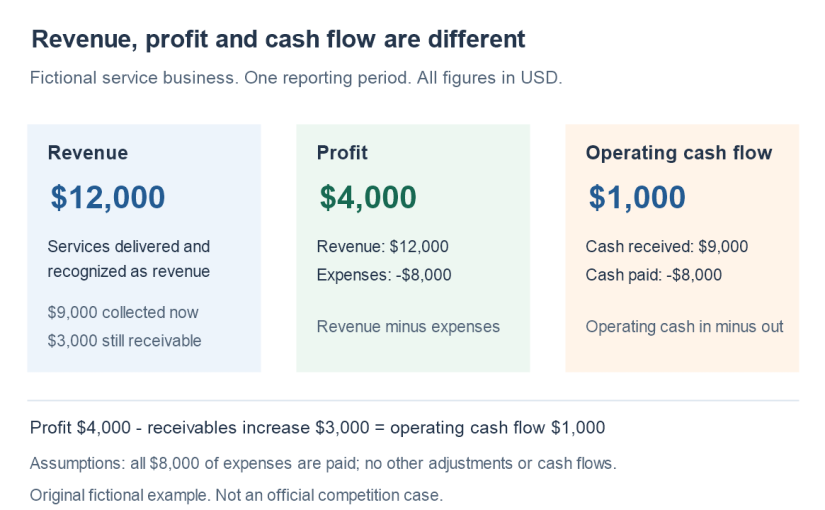
Revenue is not automatically cash received, and profit is not automatically cash generated. A short fictional example makes the distinction concrete.
A service business with $12,000 of revenue
Imagine a small service business during one reporting period. These are its only transactions:
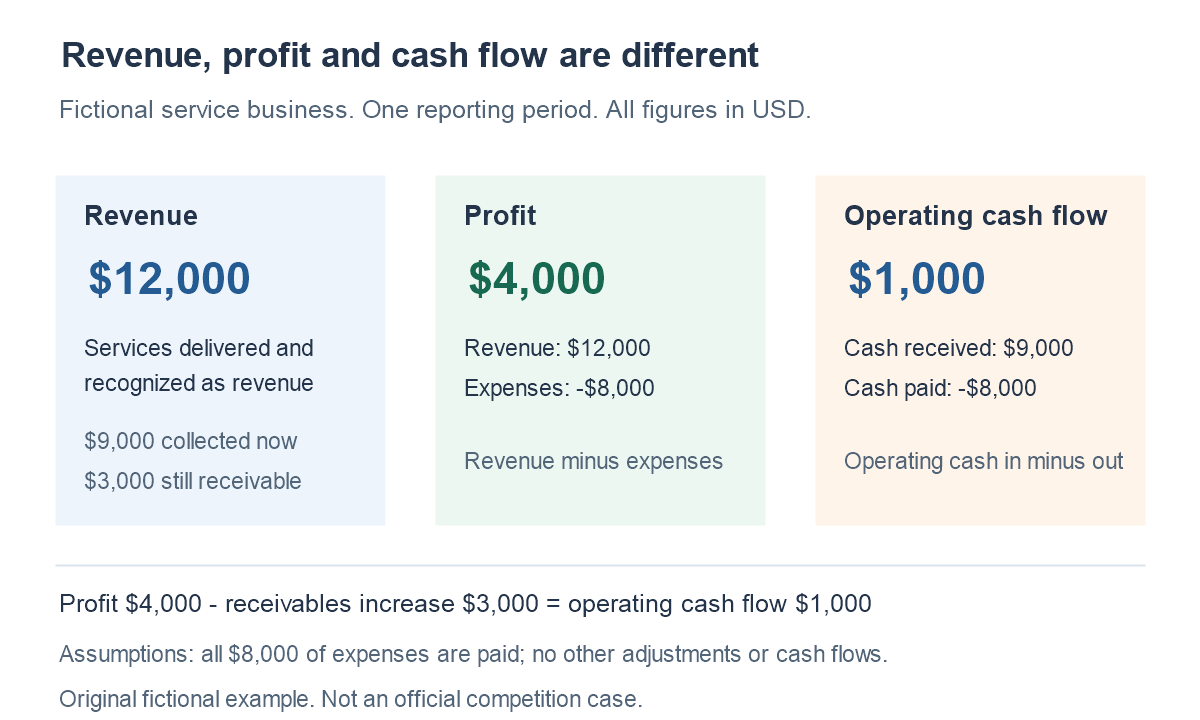
- It completes and bills $12,000 of services, all of which qualify for revenue recognition in this period.
- Customers pay $9,000 before the period ends. The remaining $3,000 is still owed to the business.
- It incurs $8,000 of operating expenses and pays all of them in cash during the same period.
Assume opening accounts receivable is zero and all other items, adjustments and cash flows are zero. These simplified figures are an original educational example, not a real company, an official competition case or an investment recommendation.
Calculate profit and operating cash flow separately
For the income calculation, use the revenue earned and the expenses incurred:
Profit = $12,000 - $8,000 = $4,000.
For the cash calculation, use the money actually received and paid:
Operating cash flow = $9,000 - $8,000 = $1,000.
The business has earned $4,000 of profit, but only $1,000 of net operating cash has arrived during the period. Neither calculation contradicts the other: they measure different things.
Find the missing link: accounts receivable
The $3,000 that customers still owe is accounts receivable. In this example, it is already included in revenue but has not yet become cash.
Because opening receivables were zero, receivables increased by $3,000. Reconcile the two calculations:
$4,000 profit - $3,000 increase in receivables = $1,000 operating cash flow.
This reconciliation works under the stated assumptions. A real company's reconciliation can contain other adjustments, so do not treat "profit minus receivables" as a complete general formula.
Cash flow is also different from the cash balance
The cash balance is an amount at a particular date; cash flow describes movement over a period. If this fictional business began with $5,000 of cash, its $1,000 increase would leave $6,000 at period end.
Real cash flow statements separate operating, investing and financing activities. The SEC guide explains these categories. Our example has no investing or financing activity, which is why its operating cash flow also equals its total cash increase.
Try two questions before opening the answers
- In the next period, the business collects the remaining $3,000 from those customers. It provides no new services and has no new expenses or other transactions. How much additional revenue, profit and operating cash flow does that collection create?
- Return to the original period, but suppose customers paid only $7,000 instead of $9,000. Keep the $12,000 of recognised revenue and $8,000 of cash expenses unchanged. What are profit, operating cash flow and ending receivables?
Show the answers and reasoning
Question 1: The collection creates $0 of additional revenue and $0 of additional profit. The revenue was recognised in the earlier period. Operating cash flow increases by $3,000, while receivables fall from $3,000 to zero. Counting the collection as new revenue would count the same services twice.
Question 2: Profit remains $12,000 - $8,000 = $4,000. Operating cash flow is $7,000 - $8,000 = -$1,000. Receivables are $12,000 - $7,000 = $5,000. The reconciliation is $4,000 - $5,000 = -$1,000. A positive profit and negative operating cash flow can therefore occur together in this simplified setting.
What this exercise establishes, and what it leaves open
The calculations establish that payment timing can separate revenue, profit and cash flow. They do not establish whether the fictional customers will pay on time, whether future sales will grow or what an ownership share would be worth.
Keep those questions separate from the arithmetic. "Customers still owe $3,000" is a stated fact in the example. "They will pay next month" would be an additional assumption unless the exercise supplies it.
For independent study, keep a note of the metric, reporting period, units and source beside each figure. Use Wharton Global Youth's public glossary to look up unfamiliar business terms, then explain them in your own words.
Use the official competition information alongside public learning
If you are exploring WGHS, begin with the official overview and our beginner's guide. Registered teams should follow the current instructions supplied by Wharton.
Wharton's General Rules & Roles prohibit paid advisors, education consultants and non-Wharton extracurricular courses claiming to teach the competition. Students are responsible for their research, decisions and submitted work. Ask Wharton and your school advisor about permitted assistance.
Explore the Wharton competition with Hanlin
Want to understand the event or find public financial-literacy resources? Scan the QR code and send WHARTON FINANCIALS. Tell us which official information or public learning links you are looking for.

On your phone, use the button above. You can also save the QR image and scan it within WeChat.
Include these details in your message:
WHARTON FINANCIALS
School grade:
Country or region:
Status: exploring a future season or already registered.
Information needed: event overview, official rules or public learning resources.
Sources: Wharton Global Youth's competition overview, FAQ, rules and glossary, and the SEC's beginner guide linked above. The fictional example, diagram and exercises were created for this article.