
As the "ceiling" of business competitions for high school students worldwide, the Wharton Global High School Investment Competition (WGHS) is not just a simulated investment game. It is a comprehensive test of business thinking, teamwork, and academic writing. To help participants precisely navigate the competition, this guide provides an in-depth breakdown across three dimensions: official hard rules, actual content tested, and the core judging logic.
I. Official Hard Rules for WGHS Participation
The WGHS enforces extremely strict regulations regarding participant qualifications and team formation. Any violation may result in immediate disqualification.
1. Participant Eligibility and Team Size
The competition is open to high school students in grades 9–12 worldwide. Participants must be strictly between the ages of 14 and 18. Each team must consist of a fixed 4–6 members, and the total number must not fall below 4 at any time throughout the competition. If a team member drops out during the competition, causing the team to have fewer than 4 members, the entire team will be directly disqualified. Homeschool students may apply separately to the official organizers for team formation.
2. School Affiliation and Advisor Requirements
Teams must follow the "same school, same campus" principle. Cross-school or cross-campus combinations are considered violations. Only students from different grades within the same school may form a team, and each student may join only one team. Registration must be completed by an in-school teacher acting as the official advisor. One advisor may supervise a maximum of 5 teams from the same school. External tutoring institution teachers cannot be registered as official advisors; they may only provide preparatory coaching.
3. Roster Adjustment Window
Team rosters may only be adjusted before the interim report submission deadline. Once the interim report is submitted, the roster is permanently locked. No changes may be made without official written approval.
II. What the Competition Tests
The entire competition consists of two core components: a 10-week simulated trading session and two English-language investment reports. Teams that successfully advance to the global top 50 must also participate in a full-English Q&A defense session.
1. Simulated Trading
Teams log in to Wharton's proprietary WInS/OTIS simulated U.S. stock trading platform and receive USD 500,000 in virtual funds. Only U.S. individual stocks and ETFs are tradable (derivatives and cryptocurrencies are not permitted). The platform's market data is synchronized in real time with the actual U.S. stock market. It is important to emphasize that investment return is not the core scoring criterion. Judges place greater value on a complete and controllable asset allocation logic. Short-term high returns achieved through high-risk bets are far less favored than a stable portfolio with sound risk control and a closed-loop logic. Data shows that teams with a Sharpe ratio of 1.5 or higher have a significantly higher chance of advancing.
2. Two English-Language Written Reports
Interim Report: Concise in length, mainly explaining the current portfolio structure, phased adjustment justifications, and supporting basic risk data. Its primary purpose is to lock in the team roster.
Final Report (recommended 10–12 pages): Must cover six core modules, including: underlying investment philosophy, target client profile, diversified asset allocation strategy, full-cycle trading review, complete risk management system, and the limitations of the investment strategy along with optimization reflections. The report should be accompanied by visual data charts. Logical completeness is a key scoring factor.
3. Defense Session (Top 50 Teams Only)
Advancing teams participate in an online semifinal, featuring a 10-minute strategy presentation followed by a 5-minute Q&A with judges. The final standout teams are invited to the Wharton School campus to participate in the in-person final defense at the Global Finale, which comprehensively evaluates the team's communication skills, quick thinking, and professional knowledge.
III. Core Judging Logic
Unlike ordinary simulated stock trading competitions that emphasize absolute returns, the WGHS judging places greater importance on the rationality and rigor of the investment strategy. In previous years, teams with the highest returns have been eliminated precisely because their investment logic was unclear and their strategies lacked rigorous justification.
The judging panel consists of Wharton School professors and senior Wall Street experts. Teams are evaluated comprehensively based on the following dimensions:
Logic of the Investment Strategy: Is the strategy clear, in-depth, and original? Is it tailored to the assumed client's financial goals?
Quality of Industry and Company Analysis: Does the team demonstrate a deep understanding of industries and companies? Are both quantitative and qualitative analytical tools employed?
Completeness of Risk Management: Has the team clearly identified and managed portfolio risks? Has excessive concentration been avoided?
Professionalism of the Report and Presentation: Is the report structure rigorous? Is the data support solid? Is the English expression and presentation professionally delivered?
Team Collaboration and Defense Performance: How well does the team work together? Is the division of labor reasonable? Is the logic clear when answering judges' questions?
Portfolio Return Performance: This is only a reference factor, not the core deciding factor.
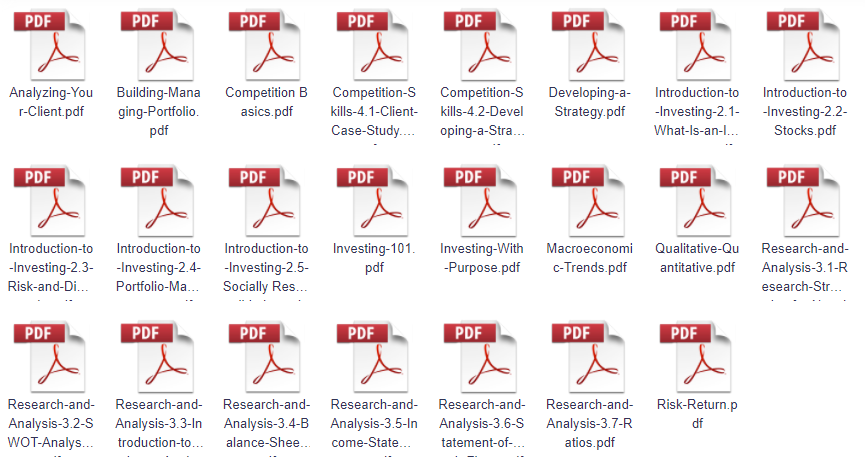
Scan the QR code to get free access to past exam papers, case studies, and required reading list.