
In the competitive landscape of extracurricular activities for international students aiming for top U.S. universities — especially the Wharton School of the University of Pennsylvania, NYU Stern, Oxford/Cambridge Economics, and top-tier Chinese-foreign joint institutions — the WGHS (Wharton Global High School Investment Competition) is undoubtedly the "number one" business competition in terms of global prestige and recognition.
Since it is officially hosted by the Wharton School of the University of Pennsylvania, an Ivy League institution, it attracts tens of thousands of top high school students from around the world to compete in teams each year.
In this article, we will use the underlying judging logic of the Wharton competition to thoroughly reveal the truth about "zero-based" success and provide you with a full-cycle preparation plan.
I. Why Can Students with "Zero Business Foundation" Still Succeed in WGHS?
Many students and parents hold a major misconception — believing that the Wharton competition is a simulated trading contest about "who makes the most money from stock trading," or a rigorous exam testing "who can memorize the most college-level financial formulas." However, this misconception is precisely why many teams composed solely of "finance学霸 (academic high achievers)" end up as cannon fodder.
The judges of the Wharton competition are all professors from the Wharton School and top Wall Street asset management experts. The core competencies they value are never about "how much money was made," but rather the following three foundational qualities that students with no prior background can absolutely master through intensive training:
Absolute Loyalty to "Client Needs": At the start of the competition, the official organizers provide approximately 10 virtual client cases with different backgrounds (for example: a trust fund seeking steady returns for charitable purposes, or a young entrepreneur aggressively pursuing tech growth stocks). A team with no prior background can win the judges' approval from the very first step as long as they strictly adhere to the client's risk preferences and execute customized asset allocation.
Rigorous "Logical Coherence" Rather Than Showing Off: Judges dislike reading papers filled with obscure "quantitative machine learning algorithms" that ultimately fail to explain why a particular stock was purchased. Conversely, if a team with no prior background can use the most basic business logic to clearly explain — "Because the client values ESG environmental protection, and the industry is currently at a cyclical bottom, we allocated 10% to a certain energy stock" — this kind of simple, self-consistent logic is the most powerful.
Teamwork and Cross-Disciplinary Problem-Solving: The Wharton competition is a months-long marathon, requiring teams of 4–7 members. A "miscellaneous" team composed of a programmer, a humanities-focused lead writer, and a mathematical modeling specialist can often produce papers with multidimensional perspectives that overwhelm teams of pure business high achievers.
II. Reject Blind Exploration! Full-Cycle "Zero-Based" Preparation Plan for WGHS
To help teams with no prior background make steady progress without detours, we have tailored a scientific full-cycle preparation roadmap based on the six-month timeline of the Wharton competition:
1. Rapid "Skill-Building" in Three Core Business Tools & Client Analysis: June – July (Team Formation & Strategic Kickoff)
Core Objective: Assemble a zero-background team and quickly build a business-thinking foundation during the first half of summer.
Execution Details: All team members focus intensively on three golden areas: fundamental analysis (learning to read the three major financial statements), industry sector analysis (mastering Porter's Five Forces and SWOT analysis), and foundational asset allocation theory (understanding risk hedging among stocks, bonds, and cash). Simultaneously, after the official case is released, the team engages in intensive brainstorming to select the "core virtual client" to focus on, and meticulously breaks down that client's long-term and short-term financial goals.
2. Simulated Trading Launch & "Interim Report" Integration: August – September (Mid-Term Strategy & Simulated Trading)
Core Objective: Enter Wharton's proprietary OTIS simulated trading system for live operations and deliver the first key deliverable.
Execution Details: Programmers and modelers steadily execute stock purchases and portfolio construction based on the team's asset allocation strategy. Meanwhile, the lead writer must begin drafting a high-quality interim report. The interim report is by no means a mere log of transactions; it must demonstrate to the judges: What market fluctuations did you encounter over the past two months? How did your team adjust positions by revising industry analysis reports? Showcase the team's dynamic adjustment capabilities.
3. Integration of Qualitative and Quantitative Analysis — Focus on the November Final Report: October – November (Final Paper Integration)
Core Objective: Enter the most demanding and decisive phase — the writing of the "20-page full-English final paper."
Execution Details: Modelers transform months of investment performance into high-definition, professional academic data charts (such as industry allocation pie charts, asset return comparison line charts). The lead writer enters intensive writing mode, articulating the qualitative logic behind every transaction with rigorous academic English. Throughout this period, the entire team must collaboratively focus on the paper's "highlight": risk management and sensitivity analysis — specifically, how your portfolio would defend against scenarios such as Fed rate cuts or industry black swan events.
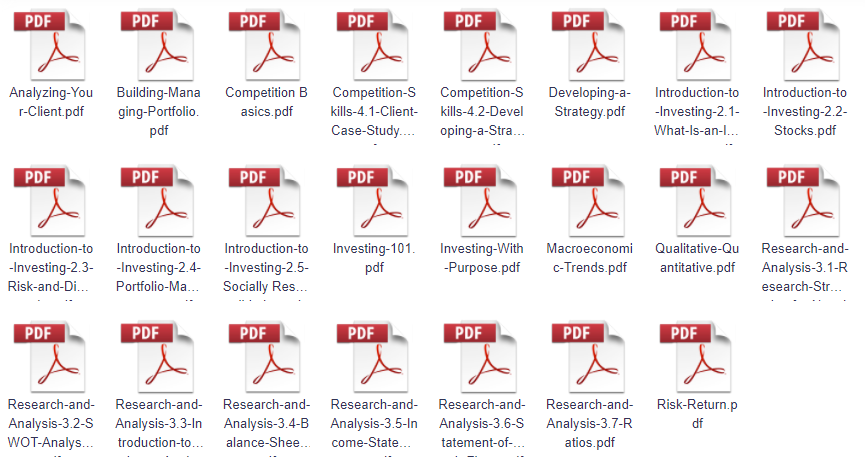
Scan the QR code to get free access to past exam papers, case studies, and required reading list.