
On the track of business-oriented extracurricular enhancement in international education, the Wharton Global High School Investment Competition is undoubtedly the "crown jewel." As a top-tier event officially hosted by the Wharton School of the University of Pennsylvania, it attracts tens of thousands of elite high school students from around the world to compete each year.
However, this also brings a common anxiety: "I've never studied accounting, I've never traded stocks — I'm a complete business 'rookie.' Can I still participate in the Wharton competition? How do I get started? What grade should I start preparing in to avoid being eliminated early?"
This article will map out a hardcore path from zero to one for you.
I. How Can Beginners with Zero Background Get Started Smoothly? (A Four-Step Strategy)
The Wharton competition is not just a "stock trading contest." Compared to short-term returns, Wharton professors place greater emphasis on the logical coherence of the strategy and the team's research and investment framework. Therefore, beginners can absolutely achieve success through systematic training.
1. Step One: Reshape Your Mindset — Say Goodbye to the "Gambler's Mentality"
Action Guide: From day one, make it clear — you are not here to guess market ups and downs; you are here to do asset management. Your task is to read the official "client case study," understand the client's (for example, a single mother saving for her daughter's college tuition) risk tolerance and financial goals. Client-need orientation is the underlying logic of the Wharton competition.
2. Step Two: Master the "Three Major Financial Statements" — Build a Solid Theoretical Foundation
You don't need to do accounting like a professional accountant, but you must be able to read the books.
Action Guide: Use your summer break to quickly conquer the Balance Sheet, Income Statement, and Cash Flow Statement. Understand what P/E ratio, ROE, and free cash flow mean. These are your "microscope" for evaluating whether a company is worth investing in.
3. Step Three: Start with Familiar Industries — Practice Writing Industry Research Reports
Action Guide: Beginners should not jump straight into complex biotech or semiconductor sectors. Start with industries you can see and touch in daily life, such as consumer goods (Nike, Coca-Cola) or established tech stocks (Apple, Microsoft). Try analyzing their business models, competitive landscape (using Porter's Five Forces), and future growth drivers.
4. Step Four: Build a "Functionally Complementary" Team
The Wharton competition requires teams of 4–7 members. Do not form a team of homogeneous peers.
Action Guide: The ideal team configuration should include: 1 team leader with strong strategic vision (responsible for overall strategy and client case analysis), 2 members proficient in quantitative logic (responsible for quantitative stock selection and Excel modeling), 2 members with excellent writing skills (responsible for drafting the final investment report), and 1 member skilled in presentation (prepared for the final defense).
II. What Grade Level Is Best to Start Preparing? (The Golden Timeline)
Since the Wharton competition is a comprehensive project spanning several months, it is recommended to follow this tiered planning approach:
1. 9th Grade (Foundation Building Phase): Broad Exposure and Business启蒙 (Enlightenment)
Grade Characteristics: Academic pressure is relatively low at this stage — a golden period for cultivating "business intuition."
Core Tasks: Read business media such as The Wall Street Journal and The Economist extensively, play some simulation business games (e.g., Cashflow), and build a foundational financial vocabulary.
2. 10th Grade (Trial Run Phase): First Competition Experience & Skill Validation
This is the perfect entry point for beginners.
Core Rationale: The Wharton competition typically runs from September to December each year. Participating in the first semester of 10th grade allows you to go through the entire competition process — from strategy formulation, buying, position adjustment, to writing the interim and final reports — and fully test all financial tools and writing standards.
Expected Goal: Even if you don't make it to the Global Finals in your first year, this hardcore experience will lay an unparalleled foundation for your "gold medal pursuit" in 11th grade.
3. 11th Grade (Sprint Phase): Results Harvesting & Essay Integration
Grade Characteristics: By this time, students have typically completed foundational courses in economics or business (such as AP/IB/A-Level Economics/Business).
Core Tasks: Return to the competition as a core team member. By now, you possess mature research and investment capabilities, with your sights set on the global top 50 or even the finals. After achieving a finalist ranking in April, seamlessly integrate it into your 12th-grade early application personal statement as the most compelling academic narrative.
III. 2026–2027 Season: How to "Precisely Warm Up" This Summer?
With a few months to go before the new season kicks off in September, prospective participants should complete the following actions this summer:
Master Basic Tools (July): Learn to use Yahoo Finance or MarketWatch, build your own watchlist, and practice reading English-language research reports.
Team Pre-Alignment (Early August): Lock in your teammates early — don't rush to form a team after the competition starts. During the summer, find past client cases and work with the entire team to derive a simulated asset allocation plan.
Business Writing Standardization (Late August): The Wharton competition has extremely high standards for report formatting, chart specifications, and citations. Learn in advance how to let data speak and avoid emotional expressions.
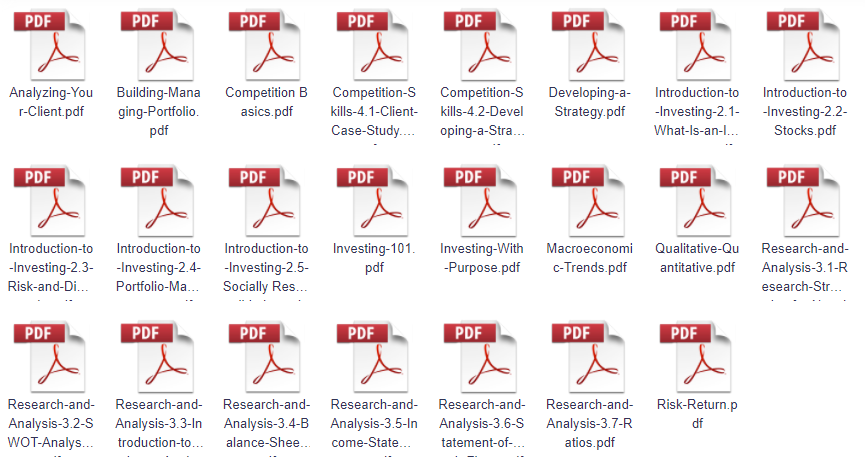
Scan the QR code to get free access to past exam papers, case studies, and required reading list.