
In the brilliant starry sky of international high school business competitions, the Wharton Global High School Investment Competition, hosted by the Wharton School of the University of Pennsylvania, is undoubtedly one of the most prestigious and globally influential team business competitions.
For every team full of ambition and eager to represent the China region in the Global Top 50 finals, there are often many core questions: What level is actually required to advance to the Global Top 50? How difficult is it to win an award in the China regional competition? What core scoring points do judges value most when evaluating business reports? If we are preparing for the 2026-2027 season, how should long-term time planning be implemented? Today, we bring you a comprehensive in-depth breakdown and advancement preparation guide.
I. Core Examination: What Level Is Actually Required to Advance to the Global Top 50?
The Wharton competition adopts a model of "team all-English business strategy report + OTIS online investment platform," attracting tens of thousands of top students from dozens of countries and regions around the world to compete on the same stage.
The value of the Global Top 50: From the massive number of teams in the preliminary round to the final announcement of the Global Top 50 semifinalists, the elimination rate is typically over 90%. Teams that make the Global Top 50 are by no means simply those who "made a gorgeous-looking PPT." They must demonstrate, in the depth of business insight, the rigor of financial models, the division of labor logic in team collaboration, and the professional expression of English business reports, a level approaching that of top North American business school undergraduates or even junior analysts.
The actual difficulty of regional awards: In the China region, due to the extreme "involution" of high-level international schools and prestigious bilingual schools, competition is exceptionally fierce. To win a top regional ranking or advancement spot in the regional competition, teams need not only solid hardcore business analysis capabilities, but also the pressure-resistant limit of delivering a business plan with high intensity within a limited time.
II. Deep Breakdown: The Three Core Scoring Points of the Wharton Business Report
When judges review business reports and investment strategy documents of hundreds or even thousands of words from around the world, their scoring standards are extremely detailed. To score high or even break into the Global Top 50, you must firmly hold the following three core scoring points:
1. The Underlying Logic of the OTIS Investment Platform and the Rationality of Asset Allocation (Quantitative Support)
The core vehicle of the Wharton competition is the OTIS investment simulator. Judges absolutely do not value how much quick money you ultimately made in the simulated portfolio (because luck plays a role), but they extremely value the investment strategy behind it:
What is your investment philosophy? Is it value investing, growth investing, or risk hedging?
How are asset allocation ratios dynamically adjusted in response to macroeconomic fluctuations? Is there solid data and quantitative model support?
2. The Depth of Team Business Insight and the Rigor of Industry Research (Qualitative Research)
When writing a business plan for a specific company or macro track, you must break away from shallow "Baike-style" listing:
Have professional business analysis tools been used (such as SWOT analysis, PESTEL model, Porter's Five Forces model)?
Do the business recommendations or investment decisions you propose have first-hand data support and rigorous causal logic derivation, rather than empty slogans based on imagination?
3. Team Collaboration Chemistry and the Standardization of English Business Reports
The Wharton competition is essentially a team battle.
Do the report's layout and charts (such as net asset value curves, industry growth rate comparison charts) possess a high degree of professional aesthetics?
Does the written expression conform to standard English business writing conventions? Is every professional term used accurately? These details directly determine the judges' first professional impression of your team.
III. Setting Sail: 2026-2027 Season Advancement and Preparation Plan (Four Steps)
If you and your teammates are targeting the 2026-2027 season Wharton competition, now is the best time for team formation and long-term planning. It is recommended to steadily advance according to the following four stages:
Stage 1: Building the "Dream Team" and Pre-Competition Fundamental Period (Current – August 2026)
Core Objective: Find like-minded teammates and complete basic business knowledge and financial vocabulary fundamentals.
Action Guide:
Form a team of 3-5 people (an ideal team should have diverse backgrounds: some good at mathematical modeling and financial analysis, some good at copywriting and logical organization, some good at coordinating presentations).
Familiarize yourself with basic financial market concepts (such as stocks, bonds, portfolios, risk exposure) and the basic structure of business reports.
Stage 2: Topic Selection and OTIS Practical Simulation Period (September – October 2026)
Core Objective: Determine the portfolio strategy and log into the OTIS platform to begin simulated operations.
Action Guide:
Based on the official competition theme announced for the season, establish your team's investment targets and main business analysis thread.
Divide team roles, begin capital allocation and simulated trading on the OTIS platform, and record a strategy adjustment review log for each stage.
Stage 3: Writing the Mid-Term Business Report and Internal Iteration Period (November – December 2026)
Core Objective: Produce the first high-quality all-English version of the business plan.
Action Guide:
Integrate macroeconomic analysis, industry competitive landscape, company fundamental research, and your OTIS investment performance data.
Invite advisors or mentors with business competition experience to conduct multiple rounds of "critical review," and conduct sweeping revisions targeting logical loopholes and imprecise data in the report.
Stage 4: Final Sprint, Finalization, and Global Selection Submission (January – February 2027)
Core Objective: Perfectly polish the final report and strive for the Global Top 50.
Action Guide:
Complete the layout, proofreading, and online submission of the final report before the official deadline.
If successfully advancing to the Global Semifinals, immediately shift to rehearsal for the all-English business roadshow presentation and high-pressure Q&A special training.
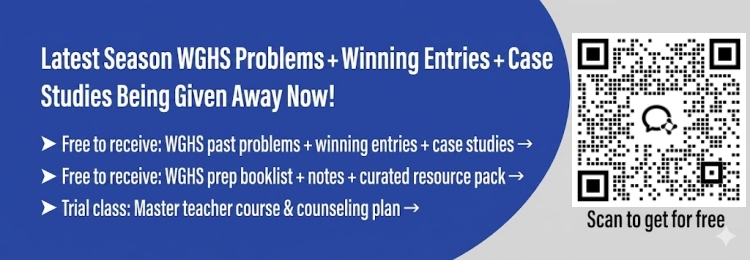
Scan the QR code to receive free past papers + case analysis + must-read competition booklist!